
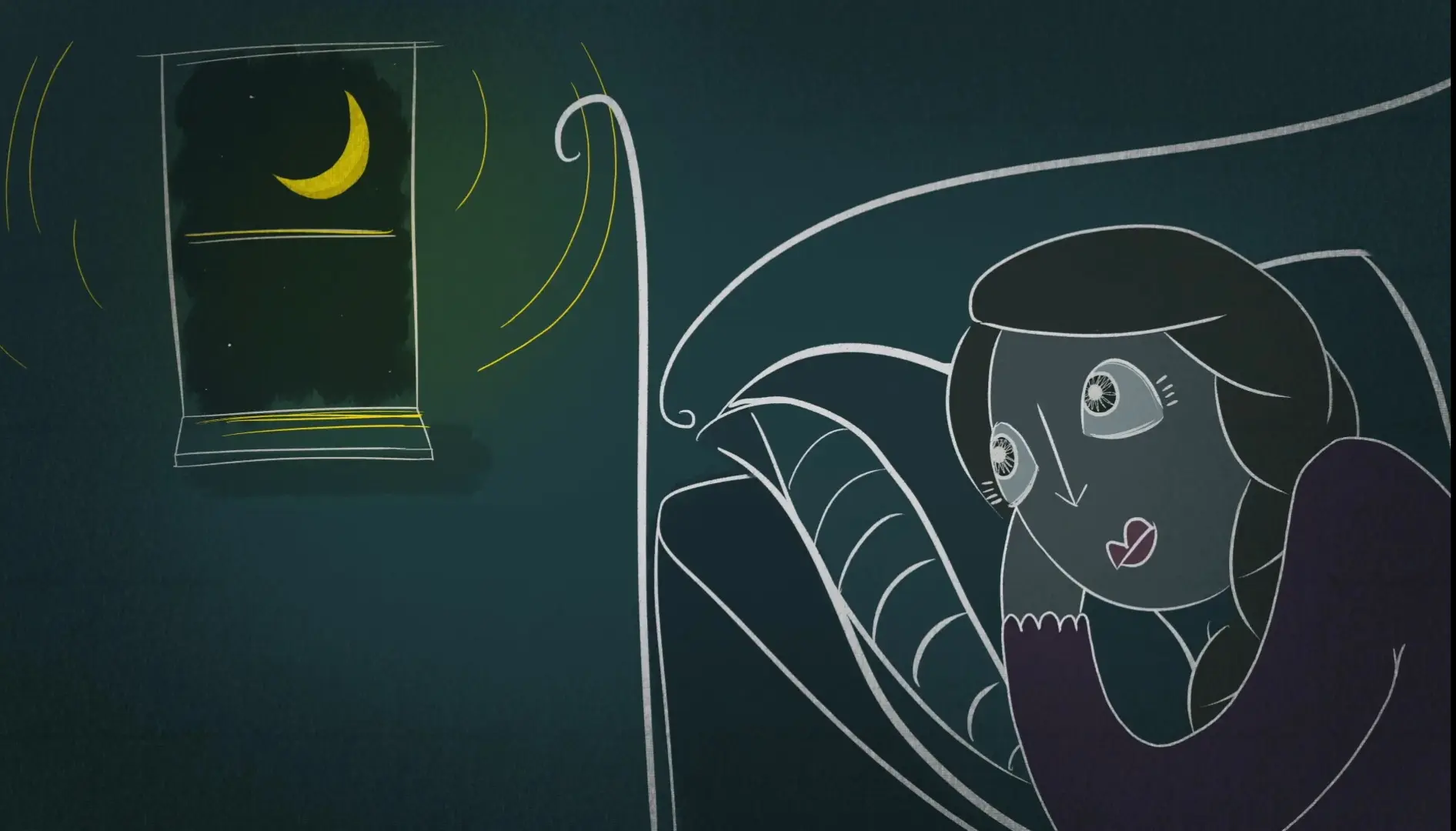
Illustration of a woman lying awake in bed at night, looking toward a window with a crescent moon.
INTERACTIVE VIDEO LESSON

What Would Happen If You Didn’t Sleep?

Video lesson + interactive tasks about sleep deprivation, why sleep is essential, and what happens to the brain and body without it.

Level: B1–B2 Format: instant check

Stage 1

GLOSSARY

Before watching, review the words that will help you understand the video.

  • sleep deprivation — the state of not getting enough sleep for a period of time
  • non-REM sleep — a stage of sleep when the body becomes calm: breathing slows, muscles relax, and the body repairs itself
  • adenosine — a chemical that slowly builds up in the brain during the day and makes you feel more and more sleepy
  • melatonin — a hormone the body produces in the evening that signals the brain that it is time to sleep
  • sleep pressure — the increasing biological urge to sleep that grows the longer you stay awake
  • glymphatic system — a network in the brain that removes waste products and toxins, mainly while we sleep
  • cerebrospinal fluid — a clear liquid that surrounds the brain and spinal cord and helps protect and clean them
  • DNA repair — the process in which cells fix damage in their DNA
  • inflammation — a reaction of the body to injury or illness that can cause redness, swelling, heat, or pain
  • Fatal Familial Insomnia — a rare inherited brain disease that gradually makes it impossible for a person to sleep normally

Stage 2

PREDICTION

Using the new words, choose the most likely topic of the video.

1) What will the video most likely explain?

Stage 3

FIRST WATCH — Listening for Gist

Watch the video once. Do not pause the video. Focus on the general idea.

1) Choose the best summary of the video.

Stage 4

SECOND WATCH — Listening for Details

Watch the video again. Focus on details. You may pause if necessary.

True / False

1) Randy Gardner stayed awake for 264 hours during the experiment.

2) On the second day without sleep, Gardner’s eyes became sharper and more focused.

3) Sleep deprivation can affect learning, memory, mood, and reaction time.

4) Adults usually need only four to five hours of sleep a night.

5) The glymphatic system is more active during sleep and helps clear waste from the brain.

Multiple Choice

1) Why do we start to feel sleepy?

2) What does caffeine do in the brain?

3) What happens during non-REM sleep?

4) What is Fatal Familial Insomnia?

5) Why can long-term sleep loss cause serious problems?

Stage 5

VOCABULARY PRACTICE

Task 1

Match the word and the picture

Tap a word, then tap an image. Listen and pronounce.

mutation
laboratory
scientist
stroke
experiment
paralysis
receptor
hallucination
dementia
hormone
scientist
experiment
hallucination
hormone
receptor
mutation
stroke
dementia
laboratory
paralysis

Task 2

Match the word and the definition

Tap a word, then tap the correct definition. Wrong answers won’t be placed.

Task 3

Fill in the gaps

Tap a word, then tap a gap. Wrong answers won’t be placed. Tap a filled gap to clear it.

Stage 6

FINAL VOCABULARY TEST (Score)

Complete the final test. Click Submit & Score.

© IrresistibleEnglish.ru
All rights reserved.