
Listening
Listen to the audio and answer the questions below.
Our Planet, Our Responsibility
Our Planet, Our Responsibility
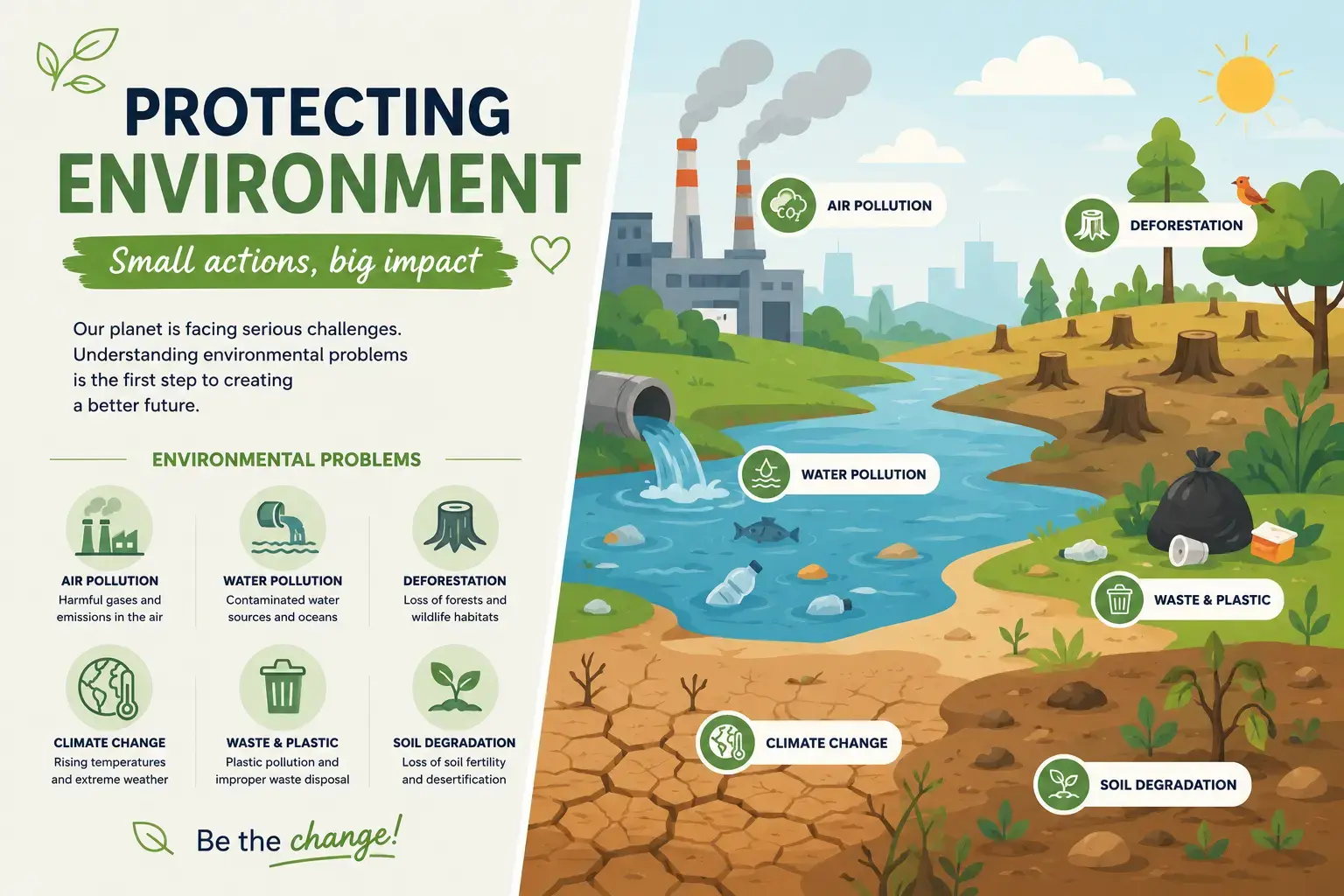
Most people don't think about the environment until they see the devastating effects with their own eyes. A river that was once crystal clear is now covered in rubbish, summer heat feels more intense than ever, and the news constantly shows another forest on fire. These are not separate, isolated incidents — they are all deeply connected.
Take the growing problem of waste. Every year, industrial factories dump millions of tons of chemical waste into water sources. As a result, many major rivers around the world have become heavily polluted rivers, completely unsafe for drinking, fishing, or swimming. And it's not just chemicals. The tons of plastic waste that people throw away daily are almost impossible to break down naturally. This plastic washes up on beaches, floats in the ocean, harms marine life, and even enters the global food chain through tiny microplastic particles.
Then there is the urgent question of our atmosphere. The air in many large cities is thick with severe air pollution, mostly because vehicles and factories give off toxic fumes. These emissions trap heat in the atmosphere, intensifying the greenhouse effect. This process is the main driver of global warming and long-term climate change. Consequently, extreme weather patterns are becoming the new normal: storms are growing stronger, summers are getting hotter, and the polar ice caps are melting at an alarming rate.
On land, the situation is equally critical. Rapid deforestation continues across the globe as millions of trees are cut down for timber and agriculture. When these forests vanish, it causes severe soil erosion and destroys the natural habitat of countless animals. A similar crisis is happening in the oceans, where decades of aggressive overfishing have pushed fish populations to the brink of collapse. If we completely wipe out these fragile ecosystems, many endangered species will die out forever, which makes global wildlife conservation more important than ever.
Fortunately, there is another side to this story, and we can still choose a different path. To reduce our global carbon footprint and protect the Earth's remaining natural resources, we urgently need to stop relying on fossil fuels. Instead, governments and modern companies are starting to invest heavily in renewable energy. You can already see efficient solar panels on rooftops in sunny regions, while in windy areas, massive wind turbines turn day and night to generate clean electricity. These green power sources do not pollute the air and will never run out.
The truth is simple: the planet does not need us — we need the planet. While the environmental challenges are serious, the solutions are well within our reach through sustainable development. Every small daily decision matters. If enough people choose to support cleaner energy and clean up their local communities, we can still secure a bright and healthy future for the next generations.
Comprehension Questions
1. When do most people start thinking about the environment?
2. What happens to rivers when factories dump chemical waste into them?
3. According to the text, what causes global warming?
4. What is one direct result of cutting down forests?
5. What has overfishing led to?
6. Which of these is an example of renewable energy?
7. Why is plastic waste a long-term problem?
8. What is the main idea of the text?
Vocabulary
A. Match the environment collocations with the definitions
Look at the picture and the phrase, then tap the correct definition. Tap a completed card to hear it again.
B. Match the phrasal verbs with their definitions
Tap a word, then tap the correct definition. Tap a completed row to hear it again.
C. Match the useful phrases with their definitions
Tap a word, then tap the correct definition. Tap a completed row to hear it again.
Vocabulary PDF cheat sheet
Download all environment collocations, phrasal verbs and useful phrases in one PDF.
Practice
A. Spelling
Two levels: build the word from letters (Level 1) or type it yourself (Level 2).
B. Fill in the Gaps — Phrasal verbs
Tap a word, then tap a gap.
1. Large areas of rainforest are being for agriculture.
2. If we don't protect endangered species, they will completely.
3. Don't those bottles — they can be recycled.
4. The world will fossil fuels one day.
5. Volunteers helped to the beach after the storm.
6. Cars and factories toxic fumes that pollute the air.
7. Plastic takes hundreds of years to in the environment.
8. The oil spill all marine life in that area.
C. Fill in the Gaps — Useful phrases
Tap a word, then tap a gap.
1. Forests are the for thousands of animal species.
2. Flying less is one way to reduce your .
3. The burning of releases carbon dioxide into the air.
4. The traps heat and warms the planet.
5. The protects us from harmful ultraviolet rays.
6. Factories release that are dangerous to breathe.
7. Plastic pollution is a serious threat to .
8. We must protect our for future generations.
9. Deforestation leads to and the loss of fertile land.
10. Climate change is causing more such as floods and hurricanes.
11. Microplastics have entered the and can now be found in seafood.
12. The polar are melting faster than scientists predicted.
13. Many organisations work on to save endangered animals.
14. The goal of is to meet our needs without harming the planet.
D. Fill in the Gaps — Environment collocations
Tap a word, then tap a gap.
1. Factories and cars cause in big cities.
2. Scientists say that is affecting weather patterns worldwide.
3. is destroying the Amazon rainforest at an alarming rate.
4. is causing the polar ice caps to melt.
5. from factories must be disposed of safely.
6. in the ocean is a danger to marine animals.
7. Many are no longer safe for drinking or swimming.
8. has caused a serious decline in fish populations.
9. Tigers and pandas are examples of .
10. is the future of our planet.
11. convert sunlight into electricity.
12. are a clean source of energy.
Test
Check your knowledge of environment vocabulary, phrasal verbs and useful phrases.